Stopping an AI agent loop is a signal-processing problem. Most teams treat it as
a prompt-engineering one — tune the instructions, set max_iterations=5, hope —
and that’s exactly why it doesn’t work. You can’t fix a control problem with a
better prompt.
Here’s the control problem. Your agent runs a verify-revise loop. Each iteration
produces an output and some measure of how wrong it still is. That measure, over
iterations, is a time series — a noisy signal. “Should the loop keep going?”
is a question about that signal: is the error trending down, flat, or blowing up,
and is that trend real or just noise? max_iterations answers a different
question entirely — “have we done this N times yet?” — which is why it stops good
loops early and lets bad ones run to the cap.
This post is how LoopGain answers the real question. It’s an open-source (Apache-2.0) library, so none of this is a black box — but the math is worth understanding even if you never read the source.
One naming note, since they look alike: loop gain (lowercase) is the control-theory quantity this post is about; LoopGain (the library) is named after it. The metric is the interesting part — LoopGain just computes it and acts on it.
The one number you have to provide: the error signal
LoopGain doesn’t define correctness for you. Each iteration, you hand it a single number — the error signal — that says how wrong the current output is:
- failing unit tests (count of failures),
- schema violations (count),
- an LLM-judge’s distance from the target,
- retrieval miss count, lint errors, whatever “wrong” means for your loop.
state = lg.observe(errors, output) # errors: a number, or a list whose length is the magnitude
Everything below operates on the sequence of those numbers. If you can’t produce an error signal, LoopGain has nothing to read — that’s the one hard requirement, and we’ll come back to it.
Loop gain: the per-step ratio, and why it’s not enough alone
The namesake quantity is loop gain, written , from the Barkhausen stability criterion in control engineering. It’s the factor by which the error changes from one iteration to the next:
means the error shrank — the loop is improving. means it held or grew — the loop is stuck or making things worse. That’s the whole intuition, and if loops were noiseless you could stop right there: watch , stop when it crosses 1.
Loops are not noiseless. A single ratio bounces around — one lucky iteration drops the error, the next recovers it, and the instantaneous ratio swings wildly even when the underlying trend is a clean decline. Act on one ratio and you’ll stop on noise. So LoopGain doesn’t act on one ratio. It reads the whole trajectory.
Step 1: work in log space
Barkhausen says — error decays (or grows) geometrically. Take the log of both sides and a geometric trend becomes a straight line:
So LoopGain transforms the error history to . Now “is this loop converging?” becomes “does this line slope down?” — and a slope is something you can fit and test instead of eyeball.
Step 2: fit the trend, then test whether it’s real
LoopGain fits an ordinary least-squares line to versus iteration. The slope of that line is the geometric-average across the whole loop — a far more stable estimate than the last single ratio.
But a downward slope on five noisy points might be chance. So LoopGain runs a two-sided t-test on the slope and gets a p-value. A trend only counts as real when — the same significance bar you’d use anywhere else. This is the difference between “the error happened to drop” and “the error is significantly decreasing.” It’s pure stdlib — a closed-form OLS slope and a Student-t p-value, no SciPy, no model.
Step 3: measure the wobble
A loop can have a flat trend and still be useless — bouncing between two answers, never settling. LoopGain detrends the log-error (subtracts the fitted line) and takes the standard deviation of the residuals. High residual scatter with a flat slope is the signature of oscillation: lots of motion, no progress.
The decision: five named states
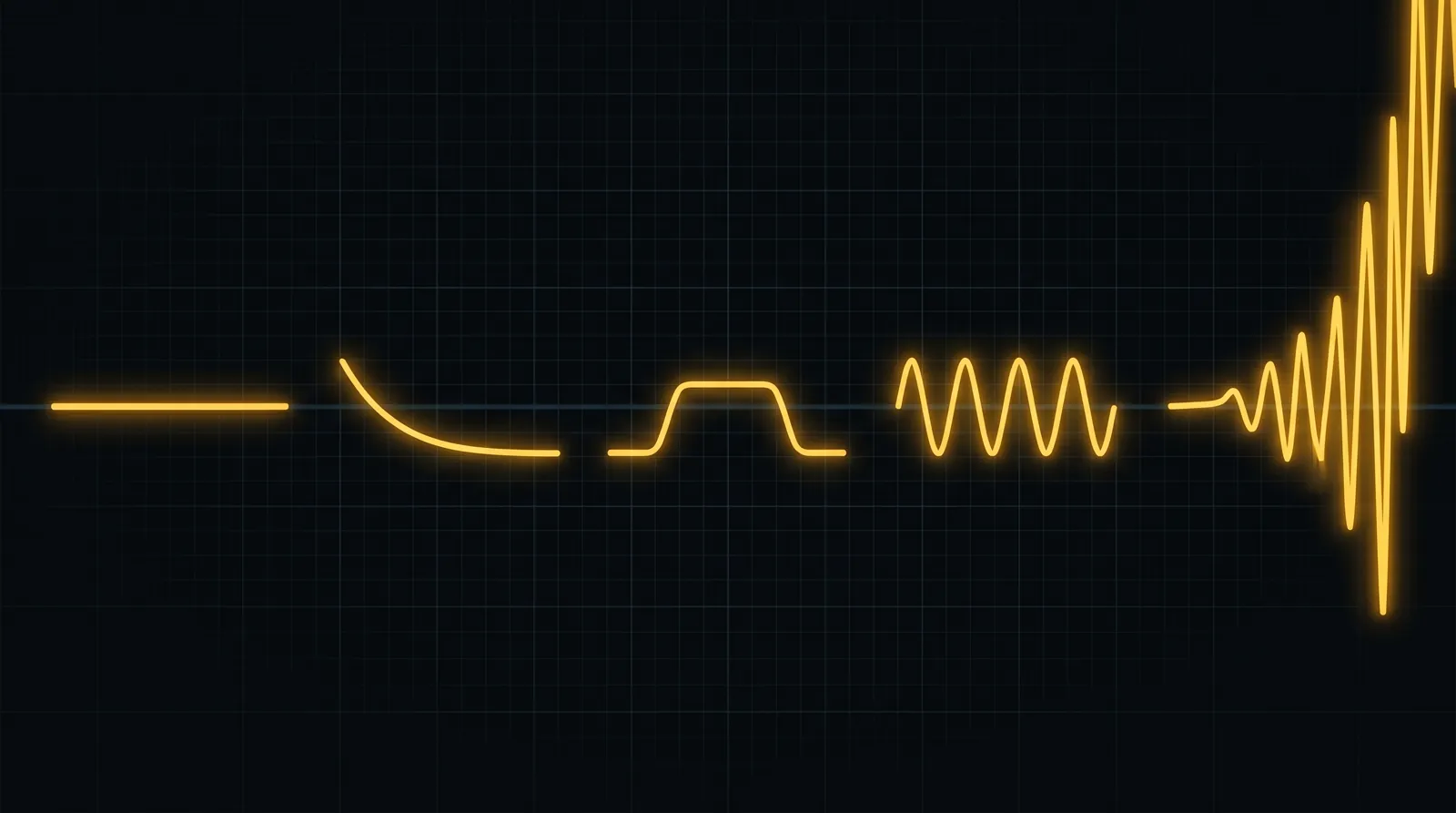
From three features — the cumulative reduction , the fitted slope and its significance, and the oscillation std — LoopGain classifies the loop’s current state. The rule, in plain form:
| State | Condition (informally) | Action |
|---|---|---|
TARGET_MET | error hit your target (e.g. zero failing tests) | stop, keep the answer |
FAST_CONVERGE | error collapsed ~10× from the start and still dropping | continue |
CONVERGING | slope significantly down (or a solid cumulative drop) | continue |
STALLING | progress has flattened — no new low for a few steps | stop once it persists, keep best-so-far |
OSCILLATING | high wobble around a flat trend | stop, roll back |
DIVERGING | slope significantly up, past a margin | stop, roll back |
The “stop, we’re done” case is TARGET_MET — a short-circuit that fires the
moment your error signal hits its target, before any trajectory math runs.
FAST_CONVERGE is the opposite of done: the error has dropped a lot and is
still dropping, so the loop keeps going. A loop only stops on a healthy trajectory when it actually reaches the
target; it stops early when the trajectory turns bad — OSCILLATING /
DIVERGING — or goes flat (STALLING).
The thresholds aren’t tuned to make a demo look good — they’re pre-registered and derived from convention: a one-decade (90%) reduction is the textbook step-response settling criterion; is standard significance; the oscillation cutoff corresponds to roughly a ±2× ripple, an underdamped response. You can override them, but the defaults come from control theory and statistics, not from fitting the benchmark.
Best-so-far rollback
When the loop stops on OSCILLATING or DIVERGING, the last output is — by
definition — not the best one; it’s the degraded one. So LoopGain keeps the output
associated with the lowest error it ever saw and hands that back:
answer = lg.result.best_output # the iteration that worked, not the last one
This is the part that turns “stop early to save money” into “stop early and return a better answer,” because on a diverging loop the last iteration is often worse than one you passed three steps ago.
Where this doesn’t work — honestly
The math has hard edges, and you should know them before you reach for it:
- Single-pass agents get nothing. One model call, no revise step, no trajectory. There’s nothing to fit.
- No error signal, no LoopGain. If you can’t put a number on how wrong an output is, none of the above runs. The quality of the control is bounded by the quality of your error signal.
- It needs a few iterations. With one or two points the slope has no degrees of freedom to test — the significance machinery can’t engage, and the cap is doing the real work.
- Gradual convergence is the rare trajectory in practice. In our 2,000-trial
benchmark, the
CONVERGINGandOSCILLATINGstates fired on well under 1% of iterations — modern LLMs tend to one-shot or stall, not glide down over many steps or thrash between answers. The states LoopGain earns its keep on are the ones that quietly burn budget:STALLING(the loop pinned, going nowhere — 21% of iterations) andDIVERGING, caught before the loop walks past its best answer.
None of this is hidden in the library. It’s a few hundred lines of stdlib Python
under Apache-2.0 — read the classifier,
disagree with a threshold, open an issue. The point isn’t that loop gain is
magic. It’s that “when is this loop done?” has an answer grounded in a century
of control theory, and max_iterations isn’t it.
LoopGain is pip install loopgain, Apache-2.0. The math here lives in the
loopgain.classifier module; the benchmark behind the “rare trajectory” claim is
open.